
The artificial intelligence revolution is here, transforming industries and offering unprecedented opportunities for growth and efficiency. But with great power comes great responsibility—and now, comprehensive regulation. The European Union’s AI Act is a landmark piece of legislation, the world’s first comprehensive framework for AI, that is poised to fundamentally reshape how businesses worldwide develop, market, and deploy AI systems.
For many small and medium-sized businesses (SMBs), the thought of navigating complex European regulations can feel overwhelming, leading to a common misconception: “This only applies to the tech giants.” This couldn’t be further from the truth. The EU AI Act’s extensive reach means that if your AI systems are offered in the EU or, crucially, even affect EU citizens, your business is likely within its scope, regardless of size.
Non-compliance isn’t just a theoretical legal risk; it carries substantial financial penalties that could be catastrophic for an SMB. Fines for serious violations can reach up to €35 million or 7% of your global annual turnover, whichever is higher. This isn’t just about avoiding penalties; it’s about building trust, fostering innovation, and securing your business’s future in an increasingly AI-driven world.
This comprehensive EU AI Act guide is designed to cut through the complexity. We’ll demystify the core principles of the EU AI Act, provide a detailed, step-by-step compliance checklist tailored for SMBs, and illustrate how approaching this regulation proactively can transform a potential challenge into a significant competitive advantage for your company.
What is the EU AI Act? A Foundation for Responsible AI
The EU AI Act was adopted in 2024 and will roll out in phases through 2025–2027. Its primary goal is to ensure that AI systems placed on the European market and used within the EU are safe, transparent, non-discriminatory, and respectful of fundamental rights. It achieves this through a risk-based approach, categorizing AI systems into four distinct levels of risk. The higher the potential for harm, the stricter the regulatory requirements. Understanding these categories is not just the first step in compliance; it’s the most critical. Misclassifying an AI system could lead to either doing far more work than necessary or, worse, failing to implement essential safeguards, leaving your business exposed.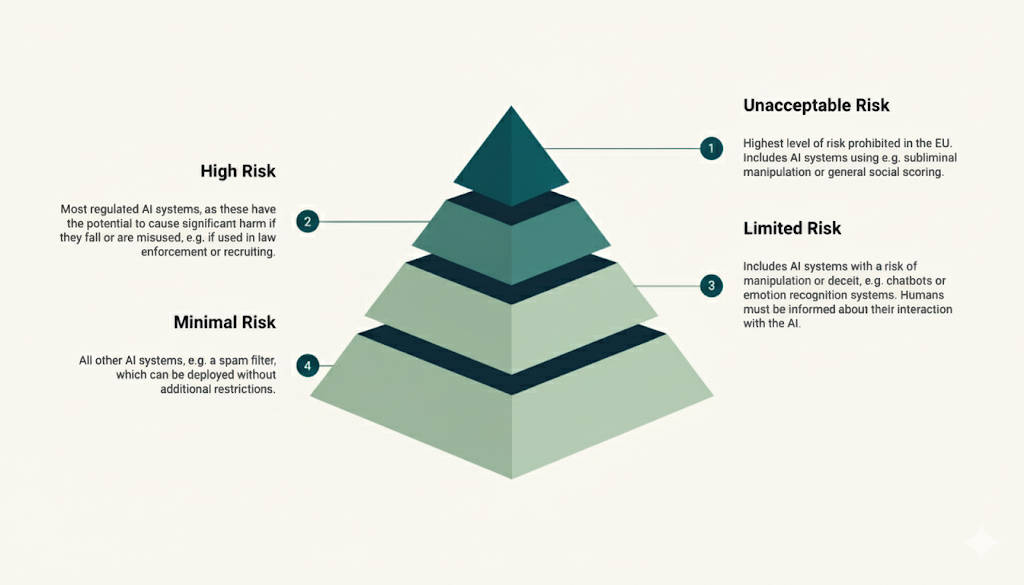
Understanding the EU AI Act’s Risk-Based Framework
1. Unacceptable Risk (Prohibited AI): The Banned List At the apex of the risk pyramid are AI systems deemed a clear threat to safety, livelihoods, or fundamental rights. These are unequivocally banned across the EU. Examples include:
- Social scoring of individuals by governments.
- AI systems that manipulate people through subliminal techniques, especially vulnerable groups like children.
- Real-time remote biometric identification in public spaces by law enforcement (with very limited exceptions). There is zero tolerance for these use cases. If your business is involved in developing or deploying such systems, they must be ceased or fundamentally redesigned to fall outside these prohibitions.
2. High-Risk AI Systems: The Heavily Regulated Zone This category includes AI applications that significantly affect people’s health, safety, or fundamental rights. These systems are not banned, but they are subject to stringent regulations and obligations. Annex III of the Act provides a detailed list, but key areas include:
- Critical infrastructure (e.g., managing water, gas, electricity).
- Employment and HR (e.g., AI for recruitment, resume screening, performance evaluation, access to training).
- Education and vocational training (e.g., AI assessing student performance or used for access to educational institutions).
- Credit scoring and essential private services (e.g., AI determining creditworthiness or access to insurance).
- Healthcare diagnostics (e.g., AI assisting in medical diagnosis).
- Law enforcement, border control, and judicial administration.
If your business provides (develops or puts on the market) a high-risk AI system, you face a broad set of strict controls. If you deploy (use) such a system in your operations, you also carry significant responsibilities, including ensuring its proper use and monitoring.
3. Limited Risk AI Systems: Transparency is Key This category covers AI systems that are generally allowed but come with specific transparency obligations. The core principle here is that users must be informed when they are interacting with or affected by AI. Examples include:
- Chatbots: Users must be explicitly told they are interacting with an AI, not a human.
- Emotion recognition systems: Must disclose their use.
- Biometric categorization systems: Requiring notification to affected individuals.
- Deepfakes and synthetic content: AI-generated images, video, audio, or text that could be mistaken for real must be clearly labeled as artificial. For limited-risk AI, formal conformity assessments are not typically required, but honesty and clear disclosure are paramount for user trust and legal compliance.
4. Minimal or No Risk AI Systems: The Light Touch The vast majority of AI applications fall into this category. These are AI systems with a negligible impact on fundamental rights or safety. Examples include:
- Email spam filters.
- AI-powered spell-checkers.
- Basic recommendation engines for entertainment platforms.
- Video games (that don’t manipulate behavior in a harmful way). Minimal-risk AI is largely unregulated under the Act, meaning you can generally use or develop these freely without specific legal obligations beyond existing laws (like GDPR for personal data). However, the Act encourages voluntary codes of conduct, promoting ethical best practices even for low-risk applications.
Key takeaway: Your business needs to inventory all its AI systems and classify the risk level of each one. Use the EU AI Act Guide to map all your AI systems or consult us to get support.
Why Do SMBs Need an EU AI Act Guide?
Many small businesses might assume AI regulation only targets tech giants or critical infrastructure. In reality, the AI Act’s obligations can affect any company using or building AI, including ordinary businesses using AI-powered tools for everyday tasks.
The law defines specific roles in the AI value chain:
- AI Providers: Those who develop or put an AI system on the market.
- AI Deployers: Those who use an AI system in business operations.
An SMB can be a provider (e.g., a startup creating an AI-driven app) or a deployer (e.g., using a third-party AI tool for HR or marketing), or even both. If there is any chance your company develops, integrates, or uses AI systems, you need to understand how to comply.
At the same time, small businesses face unique challenges: limited resources, less in-house legal or technical expertise, and potential confusion over complex technical requirements. This guide aims to break down the AI Act in clear terms and distill a compliance checklist to help SMBs methodically address each obligation.
What Are the Key Compliance Requirements?
If your inventory reveals you have high-risk AI systems, those will demand the most attention. The majority of the AI Act’s obligations fall on providers (developers), but deployers (users) also have duties. Here are the core compliance requirements for high-risk AI.-
- Risk Management System: This isn’t a one-off document; it’s an ongoing process. You must identify and evaluate foreseeable risks, from bias and discrimination to technical failures. You must then take steps to mitigate those risks and continuously monitor the AI’s operation for new risks throughout its lifecycle.
- High-Quality Data and Data Governance: Biased or incomplete datasets can lead to unfair outcomes. The Act requires that the data used to train and test your AI is relevant, representative, and free of errors. Good data governance also means documenting your data collection and processing practices and complying with existing privacy laws like GDPR.
- Technical Documentation: You need to prepare extensive technical documentation for your AI system. This file should detail its design, development processes, training data, algorithms, and performance characteristics. An external expert or regulator should be able to review this documentation and verify how the AI was built and that it meets the Act’s requirements.
- Transparency and Human Oversight: Your AI system should not be a black box. You need to provide clear, user-facing information on what the system does, its limitations, and its potential risks. Furthermore, you must design your AI with human oversight in mind, allowing operators to understand its outputs and intervene or override decisions if necessary. This might mean having a “human-in-the-loop” for critical decisions.
- Accuracy, Robustness, and Cybersecurity: High-risk systems must be accurate, robust, and secure. You should test your AI to ensure it performs reliably under different conditions and is resilient against attempts to tamper with or game the system.
- Conformity Assessment and CE Marking: Before a high-risk AI system can be deployed or sold in the EU, it must undergo a conformity assessment and obtain a CE marking (Conformité Européenne) to show it complies with all AI Act requirements. This process is similar to how many other regulated products are certified for the EU market.
Need help with compliance?
Navigating these requirements can be complex and time-consuming. At Maiju, we specialize in helping small businesses like yours. We can conduct an AI audit, help you with risk assessments, and streamline the documentation process. Our AI consultancy services are designed to help you meet the EU AI Act’s demands efficiently, so you can focus on running your business.The EU AI Act Guide Checklist
Now for the practical part. Use this checklist to guide your business toward AI Act compliance.
- Inventory Your AI Systems and Uses: Start with an AI audit. Compile a list of all AI systems you use, including any third-party services. Document each system’s purpose, how it works, and what decisions it influences.
- Identify Your Role: For each system, determine if you are the provider (developing or significantly modifying the AI) or a deployer (using AI developed by someone else). Your obligations will differ based on these roles.
- Classify the Risk Level: Assess which risk category each AI system falls under. Document your rationale for the classification. This will determine which requirements apply to you.
- Implement Required Controls for High-Risk AI: If an AI system is classified as high-risk, work through all the mandated controls. Set up a risk management process, ensure your data is high-quality, and prepare all the necessary technical documentation.
- Ensure Transparency for Limited-Risk AI: If you use limited-risk AI systems, implement the required transparency measures. This typically means providing a clear disclosure whenever users interact with or are affected by the AI.
- Provide Training and Establish Oversight: The Act requires organizations to foster appropriate AI literacy. Train your staff who develop, deploy, or monitor AI systems so they understand the technology’s risks and limitations.
- Document Everything: Create and maintain the necessary documentation and records, especially for high-risk systems. This includes the technical file, risk assessment reports, and logs of the AI system’s activity.
- Plan for Conformity Assessment: If you have high-risk AI, plan for a conformity assessment well in advance of the deadlines. This process can be time-consuming.
- Monitor, Report, and Improve: Compliance doesn’t stop at launch. Continuously track the AI system’s performance and compliance, and have a plan to address issues or serious incidents.
The Road Ahead: Key Dates and Deadlines
The EU AI Act is phasing in over several years to give businesses time to adapt.-
- August 2, 2025: Rules for general-purpose AI models (like LLMs) and the penalties regime become enforceable.
- August 2, 2026: Most of the AI Act’s requirements for high-risk AI systems fully apply. This is the new rulebook for doing AI business in Europe.
- August 2, 2027: A final deadline hits for a subset of high-risk AI systems that are safety components of products regulated by other EU laws.
Turning Compliance into Opportunity
Complying with the EU AI Act will be a challenge, but it is also a tremendous opportunity. Proactive compliance will improve the quality and reliability of your AI systems, making your products or services more robust. It also builds customer trust. In an era of growing public concern over AI ethics, being able to honestly say that your AI is transparent, fair, and safe is a powerful selling point.
Early compliance can also be a significant competitive differentiator. While larger competitors might move slowly, a small business that quickly adapts can position itself as a trustworthy innovator in the market. There may even be new business opportunities in offering AI Act compliance tools or consulting once you’ve mastered it internally.
Remember, you’re not alone in this process. Use the resources available, stay informed, and engage with experts. By taking a proactive approach, you can ensure your business not only survives under the AI Act but thrives by delivering solutions that are both innovative and compliant.
Are you ready to take the first step toward EU AI Act compliance?